
2025 NH State Wildlife Action Plan Now Available
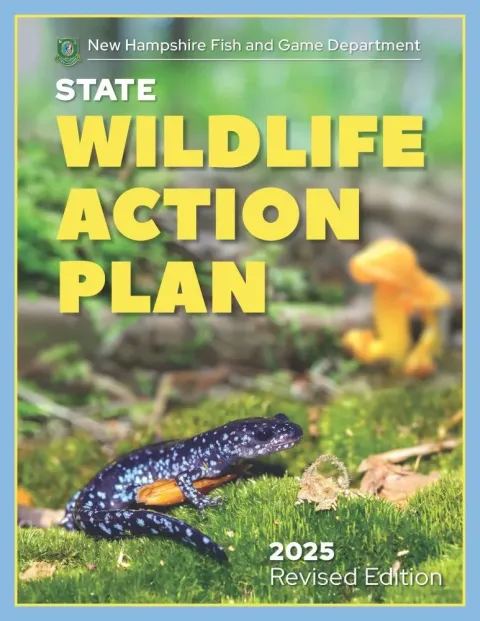
New Hampshire has released a comprehensive update to its State Wildlife Action Plan, establishing conservation priorities for wildlife and habitats across the state through 2035. The ten-year plan provides a framework for protecting threatened and endangered species, conserving priority habitats, and maintaining healthy populations of common species.
The two-year revision process was led by NH Fish & Game Department and involved collaboration among biologists, conservation organizations, universities, and state agencies. Expanded public and partner engagement - including surveys, stakeholder focus groups, and a public comment period - helped shape the Plan’s structure, priorities, and implementation strategies, resulting in a more accessible, effective document. More than 1,200 residents from 212 communities contributed through an online survey, demonstrating strong statewide engagement and support for science-based conservation planning.
A Roadmap for Wildlife Conservation
The State Wildlife Action Plan (SWAP) functions as a guiding document for state agencies, towns, conservation groups, landowners, natural resources professionals, and other stakeholders working to protect, conserve, and manage New Hampshire's wildlife and habitats. The 2025 SWAP identifies 138 species of greatest conservation need (SGCN) and outlines targeted actions to address threats to their survival and habitat. The updated list reflects both conservation progress and emerging challenges. Species such as bald eagles have recovered sufficiently to be removed from the list, while several shorebird species have been added due to steep population declines linked to habitat loss and other threats.
New to the 2025 NH SWAP is the inclusion of plants, with 188 plant species identified as SGCN using criteria that considered regional conservation rankings, habitat associations, and vulnerability to actionable threats. A new category - Assessment Need Species - was created to identify species requiring additional data to determine conservation status; this list includes 160 wildlife and 217 plant species. The plan also includes information on the distribution, status, threats, and conservation actions for 28 wildlife habitat types.
A key feature of the revised plan is the release of updated habitat maps, among the most widely used tools in the Wildlife Action Plan. The refreshed Habitat Land Cover, Highest Ranked Habitat, and Aquatic Habitat Maps incorporate the best available science and data to support informed decision-making at the local and state levels. The updates incorporate new high-resolution land cover data from 2025, improving the accuracy of saltmarsh and developed area mapping and adding a new shrubland habitat type. Revised National Wetlands Inventory (NWI) data were also integrated, providing a more complete and current picture of New Hampshire’s diverse habitats to support informed planning and conservation efforts statewide.
A redesigned Chapter 5 organizes broad conservation actions under six themes: habitat restoration and management, species management, land conservation, land use planning, education and engagement, and policy and governance. These actions provide focused strategies to effectively protect, conserve, and manage New Hampshire's wildlife and habitats, and add to the many species- and habitat-specific actions found throughout the Plan.
Federal Approval & Funding Support
The 2025 State Wildlife Action Plan was submitted to the U.S. Fish and Wildlife Service on September 30, 2025, and received official approval on December 16, 2025. Funding for the plan is provided through State Wildlife Grants administered by the U.S. Fish and Wildlife Service.
As a federally recognized plan, approval of the NH SWAP ensures that New Hampshire remains eligible for critical grant funding to support habitat restoration, species monitoring, research, and community-based conservation initiatives.

