

Bigger is Better
Vernal pools are often-overlooked features on our landscape. They are seasonal, holding water for only a few months each year. They vary greatly in size—pools with high ecological value can be incredibly small. During the times of year when they are dry, they often go completely unnoticed by those who aren’t accustomed to recognizing the subtle signs of their presence.
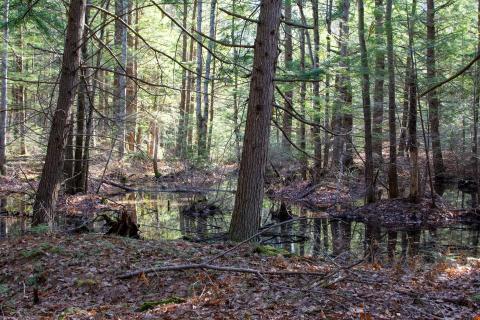
Photo by Amy Gaudreau, UNH Extension.
Despite their modest appearance, vernal pools are critically important ecological resources. They provide essential habitat for a range of wildlife species – including spotted salamanders and wood frogs – that depend on them for breeding. While these species rely on vernal pools each spring to lay their eggs, they spend most of the year in the surrounding upland habitat. In some cases, they may travel hundreds of feet into the forest after breeding season, spending late summer, fall, and winter beneath leaf litter or burrowed into the soil. For this reason, maintaining healthy amphibian populations requires protecting not only the pool itself, but also the surrounding upland area.
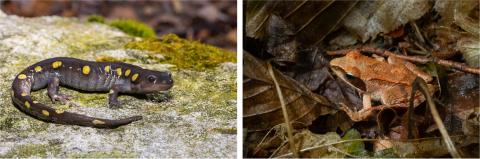
Spotted salamanders and wood frogs are just two of the many species that either rely on or regularly use vernal pool habitats. Adobe Stock photos.
Through our work providing wildlife-related assistance to communities, the Taking Action for Wildlife team frequently hears from municipalities interested in strengthening vernal pool protections. Last year, we began working with the city of Lebanon to help strategize the addition of specific vernal pool protections to their existing wetlands ordinance. Their first question was straightforward: How big is big enough? In other words – How much upland habitat around a vernal pool needs to be protected to ensure it continues to function for the species that rely on it?
In some ways, this is an easy question to answer. When it comes to vernal pool buffers, bigger is generally better. The more upland habitat that is protected, the more likely the pool will continue to serve as high-quality habitat for a variety of species. However, the reality is more complex. Communities must balance natural resource protection with development needs, potential impacts on private landowners, political will, and community priorities.
Selecting an appropriate buffer distance requires considering these local factors – each community’s needs, goals, and tolerance for regulation will differ. As a starting point, we worked to help Lebanon understand the ecological perspective: What does research suggest about the size of buffer required by amphibians that breed in vernal pools? The answer is that the distance is likely greater than what most municipalities can realistically protect through land-use regulations. Still, the information provides a strong foundation for thoughtful conversations about vernal pool protection in any community.
| Distance | Information/Data | Source |
200 feet from pool edge (breeding habitat)
950 feet (core habitat) | Breeding habitat includes the vernal pool basin and a forested buffer extending 200 feet from the pool edge. The pool basin is the physical breeding location for vernal- pool-dependent species and a nursery for their eggs and larvae. The buffer helps protect the pool’s water quality by filtering sediment and pollutants, providing shade, and slowing surface run-off.
Core habitat extends from the breeding habitat out 950 feet from the pool edge. It provides habitat for amphibians of all ages during the nonbreeding season and provides aestivating and basking habitat for spotted and Blanding’s turtles. | Good Forestry in the Granite State: Recommended Voluntary Forest Management Practices for New Hampshire. (2010). New Hampshire Department of Resources and Economic Development ‒ Division of Forests & Lands; University of New Hampshire Cooperative Extension; Society for the Protection of NH Forests.*
*Includes specific recommendations for forestry activities/best management practices in the pool basin, within 200 ft of the pool, and beyond 200 ft. |
| 400 feet | Include information on maximum and mean distances for Maine’s vernal pool amphibian indicator species, ranging from 422 to 2051 feet. Provide forestry-specific guidelines with a two-tiered buffer and different activities allowed at varying distances from the pool - a vernal pool protection zone (100 ft), and an amphibian life zone (100-400 ft). | Calhoun, A. J. K. & deMaynadier, P. G. (2004). Forestry Habitat Management Guidelines for Vernal Pool Wildlife. (MCA Tech Paper No. 6)
https://www.maine.gov/dacf/mfs/projects/kennebec_woodlands/downloads/documents/vernal_pool_hmg.pdf |
| 300 feet | Average adult migration distance for Spotted Salamanders (358 ft) and Wood frog (400 ft).
Several recommendations shared, including: Retain cover objects such as leaf litter, surface stones, and fallen logs in corridors between adjacent wetlands and within 300 feet of all wetlands. | Tarr, M., & Babbitt, K. J. (2008). The importance of hydroperiod in wetland assessment: A guide for community officials, planners, and natural resource professionals. University of New Hampshire Cooperative Extension. https://extension.unh.edu/sites/default/files/migrated_unmanaged_files/Resource000812_Rep847.pdf |
| 330 feet | Median width recommended by study authors to provide habitat for terrestrial wildlife was 330 feet. Based on literature review, but is related to wetlands and wildlife, in general, and not specific to vernal pools and associated species. | Flanagan, S. E., Patrick, D. A., Leonard, D. J., & Stacey, P. (2017, November 28). Buffer Options for the Bay: Exploring the Trends, the Science, and the Options of Buffer Management in the Great Bay Watershed: Key Findings from Available Literature. New Hampshire Chapter of The Nature Conservancy. https://bufferoptionsnh.org/wp-content/uploads/2017/12/BOB-Coastal-buffer-literature-review_11.28.17-FINAL-3.pdf |
| 256 feet | Mean recommended minimum buffer width of 256 feet for amphibians based on literature review conducted by NH Association of Natural Resource Scientists. | Wetland Buffer Scientific Work Group, "NHANRS Scientific Wetland Buffer REPORT" (2017). PREP Reports & Publications. 386. https://scholars.unh.edu/prep/386
|
| 534 feet | Summarized data from the literature on terrestrial habitat use by one group of pond-breeding salamanders. Predicted a buffer zone of 534 would encompass 95% of individuals. Note that the studies included weren’t specific to NH, but did include several species found here – Jefferson, Spotted, and Marbled salamanders. | Semlitsch, R.D. (1998). Biological Delineation of Terrestrial Buffer Zones for Pond-Breeding Salamanders. Conservation Biology, 12: 1113-1119. https://doi.org/10.1046/j.1523-1739.1998.97274.x Foundational review paper |
| 348 feet | Study in east-central Maine that used clear cutting to experimentally manipulate upland buffer widths; each pool was randomly assigned to either >1000-m buffer, 100-m buffer, or 30-m buffer. Tagged spotted salamanders moved an average of approx. 348 feet from breeding pool, but many moved beyond 500 feet. | Veysey, J. S., Babbitt, K. J., & Cooper, A. (2009). An experimental assessment of buffer width: implications for salamander migratory behavior. Biological Conservation 142:2227–2239. https://www.sciencedirect.com/science/article/abs/pii/S0006320709002067 Provides regional insight into the impact of forest harvesting on salamander movement. |
| 330 feet | Tagged adult wood frogs in central Maine and tracked their post-breeding behavior. There were either 100 ft or 330 ft forest buffers surrounded by a 330ft wide clearcut; reference cites had pools surrounded by uncut forest. Results indicated the 100ft buffers might not provide sufficient habitat to support adult wood frog populations. Encourage use of larger forest buffers (≥330 feet) in addition to the preservation of intact forest beyond the disturbed area (e.g., clearcut) as key parts of a management plan. The mean and median net emigration distances for both sexes at reference sites (undisturbed forest) were approximately 300 feet from the breeding pool. | Freidenfelds, N. A., Purrenhage, J. L., & Babbitt, K. J. (2011). The effects of clearcuts and forest buffer size on post-breeding emigration of adult wood frogs ( Lithobates sylvaticus). Forest Ecology and Management, 261(11), 2115–2122. https://doi.org/10.1016/j.foreco.2011.03.005 |
Additional Considerations:
- A buffer is a naturally vegetated area. A setback is a specified distance from a water body within which certain activities are restricted. The language you use in your zoning matters/is important relative to your intent.
- Habitat quality matters, not just distance. A buffer needs to be suitable upland habitat (forest leaf litter, coarse woody debris, canopy, low road density). Disturbed or open buffers (mowed lawn, bare ground) are much less protective than intact forest.
Additional Resources:
- Semlitsch, R.D. and Bodie, J.R. (2003). Biological Criteria for Buffer Zones around Wetlands and Riparian Habitats for Amphibians and Reptiles. Conservation Biology, 17: 1219-1228. https://doi.org/10.1046/j.1523-1739.2003.02177.x
- Veysey Powell JS, Babbitt KJ (2015) An Experimental Test of Buffer Utility as a Technique for Managing Pool-Breeding Amphibians. PLOS ONE 10(7): e0133642. https://doi.org/10.1371/journal.pone.0133642
- Buffer Options for the Bay: https://bufferoptionsnh.org/
For more information about vernal pools in New Hampshire:
- Vernal Pools: Habitat Stewardship Brochure
- NH Fish & Game Vernal Pool Identification & Documentation Manual
- Vernal Pool Resources from the Harris Center for Conservation Education

