
Engage Visitors on Your Conservation Lands
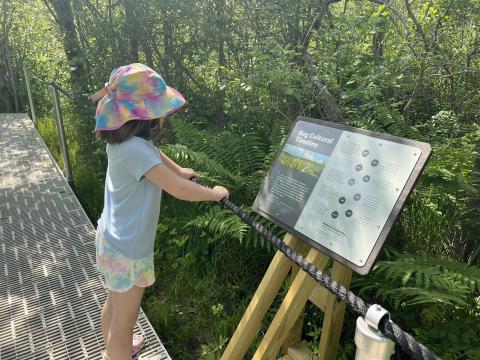
A young visitor learns about the importance of bog habitats and the history of land-use at New London’s Philbrick-Cricenti Bog.
We hear from many towns interested in adding interpretive (or educational) signs to their conservation lands. Town-owned conservation lands with well-established trail systems can be a great place to install interpretive signs. A well-designed sign can be an important tool to engage and educate visitors on a variety of topics related to the land from highlighting important wildlife habitats, to featuring interesting wildlife or plant species, to telling land-use history. They can also be used to call visitors to action – to learn more about and protect important or rare wildlife habitats and species, to share the information with others, to contribute to iNaturalist, or support future conservation.
Here are some key tips and resources to help in developing high quality signs:
The Right Site
- Signs will get the most visibility along well-established trails with good access. Ideally the property has good and ample parking, a relatively short, level and easy trail.
- The property should have interesting and unique features to showcase.
Message and Design
- Clearly identify your goals and objectives for each sign.
- Keep the message and language clear and simple.
Use a balance of text and graphics (2/3 graphics and 1/3 text).
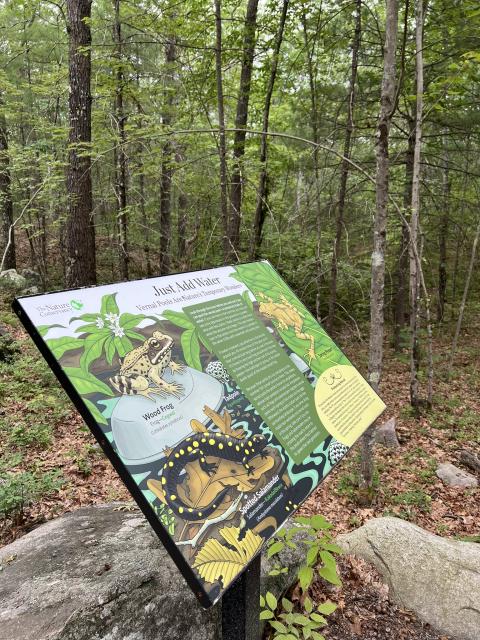
A sign at The Nature Conservancy’s Manchester Cedar Swamp All Persons Trail provides visitors a peek into the world of vernal pools.
Use Existing Resources – Don’t reinvent the wheel. Use existing resources (with proper credit) to develop your content and learn more about best practices.
- New Hampshire State Wildlife Action Plan, NH Fish and Game – use the habitat and species profiles for detailed information to help develop content.
- The Wildlife Habitat Stewardship Brochures and the Focus on Wildlife Brochures, produced by UNH Cooperative Extension may also be helpful in developing specific content.
- Educating Trail Users: Advice for Planning Interpretive Trail Signs and Exhibits, American Trails/California State Parks – an overview of top tips for interpretive signage.
- A Guide to Accessible Kiosk and Map Design, Green Goat Maps/American Trails – a new resource with great standards for accessibility.
- Wayside Exhibits: A Guide to Developing Outdoor Interpretive Exhibits, National Park Service – a deep-dive into the details of interpretive sign design.
Professional Resources
- Consider hiring a professional to design and layout your signs – a cohesive design with engaging graphics are helpful in grabbing and keeping visitors’ attention.
- Choose a printing service that can print signs on rugged and UV resistant materials.

