

Five Years of the New Hampshire Butterfly Monitoring Network
Five years ago, a group of dedicated volunteers helped launch what would become a statewide effort to understand and conserve New Hampshire's butterflies. The New Hampshire Butterfly Monitoring Network (NHBMN), has brought together volunteers, conservation organizations, educators, land trusts, conservation commissions, and wildlife biologists to better understand the state's more than 100 butterfly species.
The Network was initiated through a partnership between the New Hampshire Fish and Game Department's Nongame Program, UNH Cooperative Extension, teacher-led butterfly clubs, and two conservation nonprofits. The goal was to establish annual statewide butterfly counts, increase our understanding of butterfly populations, and provide opportunities for people to become involved in community science and conservation. Today, five nonprofit conservation organizations, multiple conservation commissions, land trusts, and many other partners participate in the effort, creating opportunities for people across the state to learn about butterflies and contribute to their conservation.
The Network provides several ways for people to participate, whether they are new to butterflies or have years of experience. At the center of the program are New Hampshire's annual Fourth of July Butterfly Counts. Eight count circles are conducted across the state as part of the North American Butterfly Association's network of more than 400 count locations. Participants spend the day exploring different habitats in small groups, learning to identify butterflies and recording the species they find. The counts are also a chance to meet other people interested in nature, learn from experienced participants, and enjoy a day outdoors.
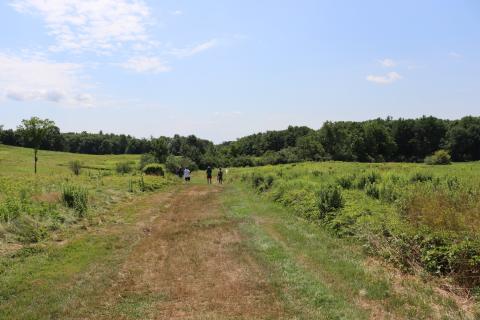
During the annual July Counts, volunteers with the NH Butterfly Monitoring Network survey for butterflies at sites around the state.
Community observations provide another important way to contribute. Since the Network began, more than 40,000 New Hampshire butterfly observations have been submitted to iNaturalist. These observations have expanded our knowledge of where species occur across the state and have documented unusual sightings, including a record of the rare Marine Blue in New Hampshire.
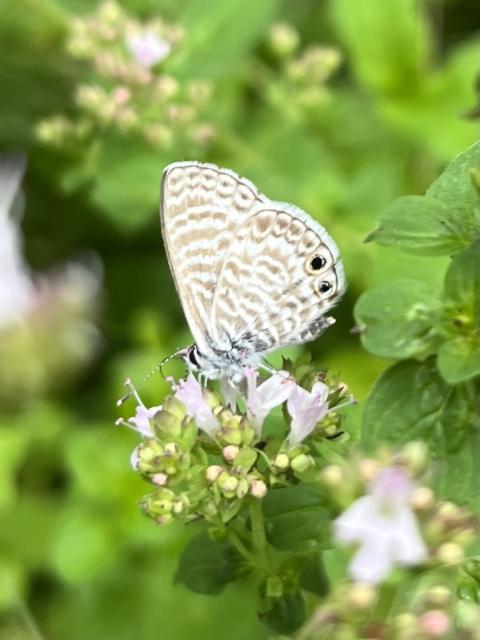
A rare record of the Marine Blue butterfly from Hill, NH in July 2026.
Photo: linesofprint on iNaturalist.
These experiences have helped volunteers build the knowledge and confidence to take the next step. Through counts, webinars, and field days, participants have developed their identification and field skills, leading to a pilot Pollard walk monitoring program in 2026. Volunteers are now monitoring established routes throughout the season, creating a foundation for long-term information about how butterfly populations are changing.
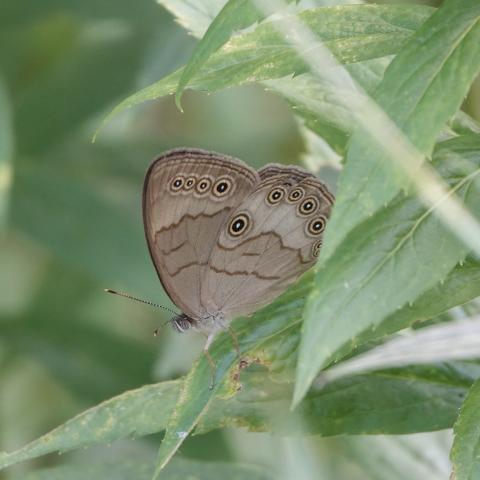
Some butterfly species, like the Appalachian Brown (pictured here), are expanding their range northward due to variations in climate, habitat, and the landscape around them.
Having good information about butterflies is increasingly important. A recent national assessment documented trends for 342 butterfly species and found that more than 72 percent are declining. At the same time, some species are expanding their ranges northward, including the Appalachian Brown and Giant Swallowtail here in New Hampshire. These changes reflect the ways butterflies are responding to variations in climate, habitat, and the landscape around them. Monitoring over many years helps us recognize and understand where conservation efforts may be needed. Information gathered through the Network has helped update species distribution maps and contributed to the 2025 revision of New Hampshire's Wildlife Action Plan.
Butterflies are more than beautiful insects that brighten our fields and gardens. They are an important part of healthy ecosystems, helping transfer energy from plants into the food web and serving as prey for birds and other wildlife. Because they respond quickly to environmental change, butterflies are also valuable indicators of habitat quality and ecological health. Protecting butterflies often means protecting the diverse landscapes and native plant communities that benefit many other species as well. This collective work reflects a growing recognition that butterfly conservation can be woven throughout our landscapes—in conservation areas, farms, utility corridors, roadsides, bike paths, parks, and even backyard gardens.
The NHBMN offers opportunities to learn, contribute observations, participate in annual counts, and, with additional training, take on more formal monitoring. Whether you are already familiar with butterflies or are simply curious about the ones you see around you, there is a place to participate. Each observation helps add to our understanding of New Hampshire's butterflies and the habitats they depend on.

