
New Hampshire's Raptor Recovery
In 1989, a single pair of Bald Eagles and just 18 active pairs of Osprey nested in New Hampshire. Today, a record-breaking 100 Bald Eagle fledglings were recorded during the 2026 breeding season, while Osprey fledglings likely surpassed this number years ago. These are true conservation success stories, but it didn't happen by luck. Years of partnerships, coordination, volunteering, monitoring, and careful management have been key to the successful population recovery of both Bald Eagles and Osprey following the devastation caused by DDT across the United States. After working for two years as New Hampshire’s Wildlife Action Plan Coordinator, followed by a year in my current position as New Hampshire Audubon’s Avian Biologist leading the raptor species projects, I often find myself both impressed and surprised by the amazing comeback of these and other raptor species. What lessons can be learned from these conservation stories, and how can we apply them to the many declining bird populations today, while still ensuring Bald Eagles, Osprey, and other recovering raptor populations remain strong?
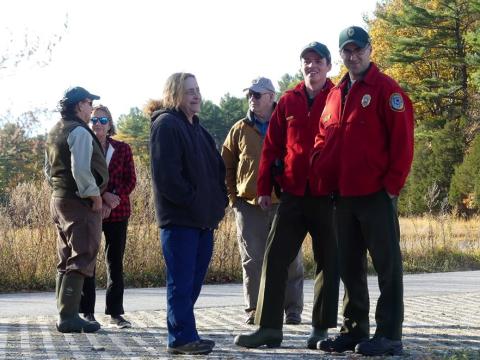
Many partners have worked together over the years to successfully bring Bald Eagles back from the brink of extinction, including NH Fish and Game Conservation Officers, wildlife rehabilitators, and NH Audubon biologists. Photo by Dyanna Smith (2019).
Strength in Numbers
Of course, we know now the extent of the destruction DDT and related pesticides caused. While the chemical was widely used for controlling mosquitos and crop pests, the negative effects on wildlife slowly began to unfold, as large numbers of birds died off and young were no longer produced. One of, if not the, most influential components of these conservation success stories is the cooperation, advocacy, and activism by so many ordinary people, not just the scientists and conservation groups. Rachel Carson’s Silent Spring was a catalyst to this movement, and it was the work of many that set in motion the years of conservation work that followed.
First, the nationwide ban on DDT in 1972, and soon after, the passage of the Federal Endangered Species Act in 1973, which provided the legal protection and framework needed for recovery to begin. These were crucial steps in the right direction, requiring many agencies, scientists, and environmental advocates, but it was just the beginning of a long road for New Hampshire’s raptors.
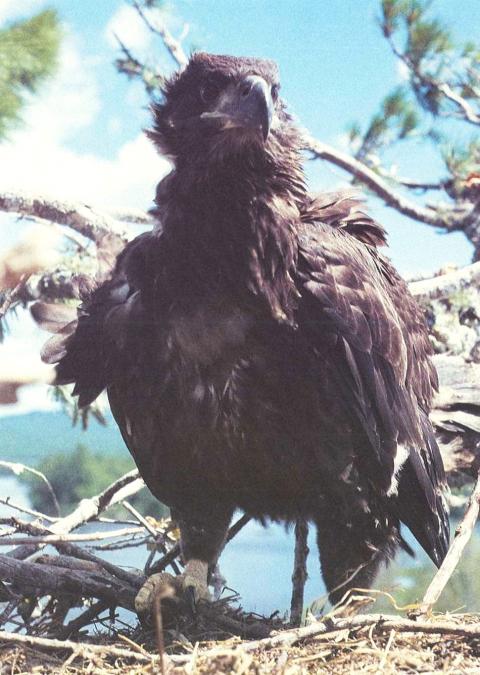
In 1989, the first post-DDT Bald Eagle pair to nest in New Hampshire was on Leonard Pond at Umbagog. After their own chick died, this orphaned chick from NY was placed in their nest to be fostered. The pair successfully fledged this chick, the first in the state in 40 years. Photo by Peter Nye (1989).
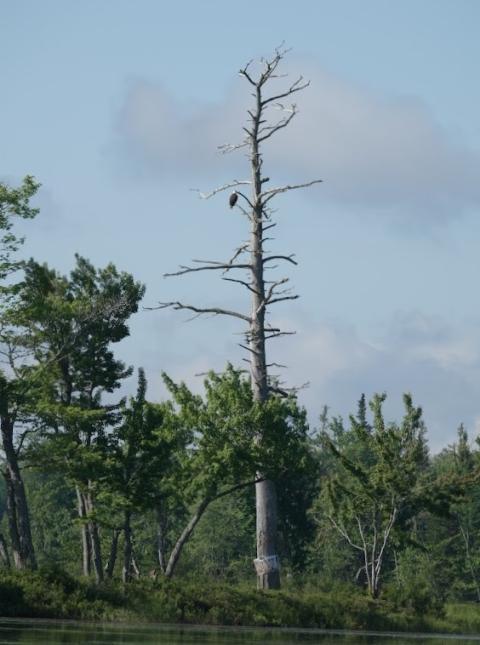
The original nest tree used by the first post-DDT Bald Eagle pair on Leonard Pond in 1989. Photo by Joe Grande (2023).
In New Hampshire, recovery was slow and uncertain, and it took wildlife agencies, nonprofits, landowners, and volunteers working together over many decades, collectively advocating for these birds. Banning DDT and passing legal protections removed the threat, but it was people who gave Eagles, Osprey, and other raptors like Peregrine Falcons, the chance to recover in New Hampshire. This is the theme I keep returning to - Bald Eagle and Osprey recovery was not inevitable, and it was a choice made by many different people who decided these birds were worth the effort.
New Hampshire’s Conservation Story
So, how did decades of work by many different stakeholders come together and culminate in thriving Bald Eagle and Osprey populations in New Hampshire? Three key elements stand out to me, all of which seem closely intertwined.
Management gives birds a headstart
Using tools such as predator guards, nesting platforms, and habitat protection gave Eagles and Osprey the conditions they needed to nest successfully, not only in pristine habitats, but also in areas shared by humans. Osprey in particular adapted to nesting on human structures, such as telephone poles. This flexibility allowed Osprey to expand across the state, but it was the partnerships and support of landowners, utility companies, and towns that enabled osprey nesting in human-dominated areas to be successful and fledge young. And keep in mind that NH Audubon and NH Fish & Game (NHFG) are available to provide technical assistance for landowners.
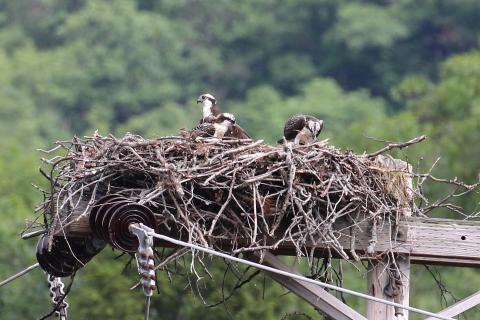
Osprey are notably adaptable and will use a variety of platforms and substrate to build their nest on. Photos by Sue Foote (2007), John Jahoda (2007), and David Forsyth (2021).
Monitoring is the foundation to any success story
However, if the biologists, landowners, and towns don’t know where and when the birds are nesting, management cannot be implemented. NH Fish and Game and New Hampshire Audubon have worked in collaboration for decades to ensure Bald Eagle, Osprey, and Peregrine Falcon population numbers are carefully tracked, building a comprehensive dataset over time. These datasets have shown consistent population growth over decades and have equipped biologists with the information they need to implement the necessary management tools, some of which are unique to each nest, to safeguard species’ recovery. Systematic annual monitoring and data collection help paint the whole picture.
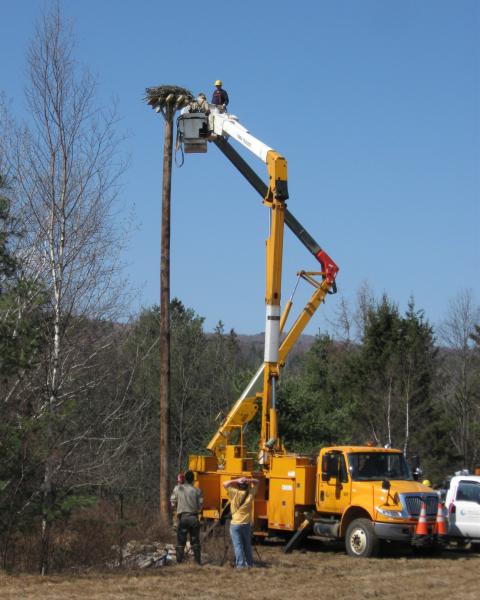
NH Audubon, NH Fish and Game, utility companies, and landowners across the state have partnered for many years to give Osprey safer places to nest. Here, an Osprey nest is carefully removed from an electrified utility pole to a newly constructed nesting platform, built and installed by the utility company. Many similar nest relocations have been performed over the years, with Osprey readily adopting the new platforms when they return north in the late spring. Photos by Chris Martin (2012).
Volunteers tie it all together
For Bald Eagles in particular, this all would not be possible without the dozens of volunteers that have dedicated their time to monitoring these birds over many years. From the beginning, volunteers have helped track each known nesting pair, carefully collecting data on nest locations, bird behavior, and phenology, year after year. This was key as limited, isolated populations began to take hold in the state. Volunteer monitors helped provide the data needed to implement management actions, giving the birds the foundation they needed to establish themselves in New Hampshire again. Then, as management strategies were executed - roosting habitats protected, predator guards installed, floating buffer zone signage on lakes, and rescue and rehabilitation, to name a few - numbers began to climb. With this came the need for more monitors in more regions of the state. Over the years, Biologist Emeritus and retired raptor project lead, Chris Martin, amassed an expansive volunteer network for Bald Eagles, Osprey, and Peregrine Falcons. To this day, these volunteers play a crucial role in the continued tracking, management, and protection of New Hampshire’s Bald Eagles and Peregrine Falcons (while formal Osprey monitoring was discontinued in 2010 due to the populations’ stability and success).
A Blueprint for New Hampshire’s Next Conservation Success Story
So, where does this leave us? Bald Eagles, Osprey, Peregrine Falcons, and other raptor populations continue to expand in New Hampshire. Novel threats, however, such as rodenticides, PFAS, and Avian Influenza loom large, and are already having an impact across the U.S. With decades-long datasets, statewide nesting location information, and a solid base of dedicated and knowledgeable volunteers, New Hampshire’s raptors can continue to be effectively monitored (in fact, Bald Eagle volunteer monitors have recently begun logging their data using a new platform, called NestStory, making the tracking of 100+ potential pairs exceptionally more efficient!)
But, what about the dozens of other species of conservation concern in New Hampshire? After spending two years pulling together the 2025 New Hampshire State Wildlife Action Plan, it’s hard not to consider the 138 wildlife and 188 plant species identified as Species of Greatest Conservation Need. While a Field Sparrow may not be as charismatic as a Bald Eagle, they and many other species are in urgent need of our help and deserve the same commitment.
If anything is to be learned from the conservation success stories of Bald Eagles and Osprey, it is that recovery starts with people. A single law, agency, or biologist did not bring back Bald Eagles or Osprey from the brink of extinction. It was many landowners, volunteers, towns, agencies, and conservation organizations committing to the same goal over decades. And we already know what tools we need: monitoring to understand what’s happening, management tailored to species’ needs, diverse partnerships, and dedicated volunteers. What’s especially encouraging is, for many species, we already know what is needed (it’s all laid out in the Wildlife Action Plan!), we just need people to show up, just as they did for Eagles and Osprey.
The NHFG Nongame and Endangered Wildlife Program is a partner and funder of raptor monitoring and management in New Hampshire.

