
Partnership to Protect Turtles in Southwestern NH
Turtles are one of the oldest reptile groups in the world and have existed for more than 200 million years. Turtles are critical to our ecosystems as predators, prey, and they spread seeds for plants, creating habitat for other wildlife. In New Hampshire, turtles become dormant for months at a time, slow down their metabolism, and survive the winter by burrowing to the bottom of wetlands. They are enduring animals and can live more than 75 years.
While they are enduring creatures, their numbers continue to decrease in their native habitat. Turtle populations are in decline because most turtles travel long distances to breeding and nesting sites. Many turtle species are slow to reproduce and do not mate until late in life (14- 20 years), and their young have very low survival rates.
To address the risk to turtle populations in Cheshire County, the Cheshire County Conservation District and along with partners at NH Association of Conservation Commissions (NHACC), the Harris Center for Conservation Education, the New Hampshire Fish & Game Department, the USDA Natural Resources Conservation Service, the NH Department of Environmental Services, and Moosewood Ecological created a regional turtle conservation initiative to support identified strategies for protecting turtle populations and by increasing public knowledge of turtles throughout our region and beyond.
The Cheshire County Turtle Conservation Initiative is a new program focused on building awareness of declining turtle species in the region, collecting data through community participation and scientific field surveys, and prioritizing restoration sites for implementation of practices that will benefit turtle species in the region. This Initiative is funded by NH Conservation License Plate (Moose Plate) program.
The Southwestern Region of New Hampshire, is habitat to a wide range of turtle species, from stable populations to turtle species at-risk including: Spotted, Blanding, and Wood turtles. Local turtle populations are at risk in our region due to loss of habitat from development, mortalities from road crossings, and climate-related impacts on wetland habitats, habitat fragmentation next to nesting sites, and migratory corridors.
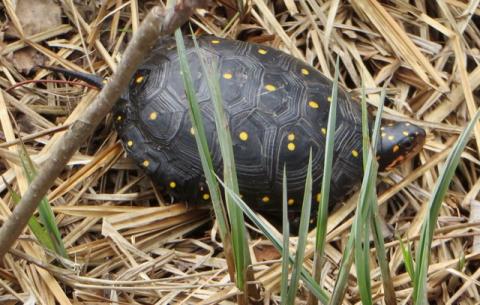
Southwestern Region of New Hampshire is home to a wide range of turtle species, including the spotted turtle seen here.
Additionally, mortalities from road crossing significantly impact regional populations. When development restricts access to habitats, turtles are forced to travel longer distances overland, increasing their risk of mortality. This regional partnership identifies the need for safe turtle crossings as a way to support species in peril. To identify significant turtle crossings, Moosewood Ecological was contracted in 2025 to develop data-driven risk-level assessments for turtle wetland-road crossings.
The Moosewood study examined habitat connectivity throughout Cheshire County, assessing culverts and other stream-crossing infrastructure for their functionality for safe passage for turtles. In general, the larger, bridge-type culverts that have low risk for flooding may also allow safe passage for turtles and additional aquatic and semi-aquatic wildlife. However, the research found that many large culverts with low flood risk assessments had higher risks for turtles and would probably also prevent other wildlife from passing under the road. Ultimately, wetland-road crossing structures should be designed to not only accommodate major floods but also allow passage by turtles and other semi-aquatic and aquatic species, such as frogs, salamanders, snakes, fish, otter, mink, and many others. Improving culvert passage and reducing road access are key elements to restoring aquatic connectivity, reducing road mortality, and potentially reducing or eliminating flooding risks at wetland-road crossings.
The report suggested options for communities such as updating current management practices and culvert replacement. Culvert management can include removing screens and periodically removing blockages created by vegetation and other debris. Another option to benefit turtle crossing is the suggestion to install fencing or guide walls to help prevent turtles from accessing roads, encouraging turtles to use the passage structure or underpass to move between habitats.
Finally, design standards for new roads with stream and wetland crossings can be amended in town regulations. These changes should focus on the development and implementation of design standards for road crossings to accommodate aquatic connectivity and water flow to adapt to increased flooding risks.
The Cheshire County Turtle Conservation Initiative created a partnership that will benefit communities by identifying critical turtle habitat and establishing a plan to protect and restore natural areas before it is too late. The report recommends additional studies to figure out the level of risk to wildlife and flooding at impaired road crossings. The Moosewood report is hopeful that, “Wetland-road crossing assessments combined with other turtle surveys would support efforts in regional, watershed, and municipal conservation planning to protect and restore wetlands, streams, and wildlife connectivity within our built environment.”
Educational Resources:

